
Phenomenal business growth from Saudi Arabia for Canada

The Profit magazine and Business without Borders did a short piece on ‘Canada’s Hottest Markets’ of growth in trade between 2005 and 2009, this December. Guess who came on top?

A market that had grown 164% in exports during this period.

That huge consuming machine and one of the wealthiest nations of the world- Saudi Arabia.

This was an interesting perspective that I thought I would spend some time on and look at some current figures and the categories of maximum potential.

As of Nov 2010, the year-to-date total exports [Domestic and re-exports] from Canada to Saudi Arabia was at $ 825.5 million, a growth of 51.8 % between the year-to-date figure in 2006 and 2010. A more than healthy growth. The key product categories that contributed significant numbers were:

Category                       CAN$ Millions
Vehicles, aircraft, vessels and associated transport equipment. 152
Machinery and mechanical appliances; electrical equipment; parts thereof; sound recorders and reproducers, television image and sound recorders and reproducers, and parts and accessories of such articles. 111
Pulp of wood or of other fibrous cellulosic material; recovered (waste and scrap) paper or paperboard. 97
Vegetable products 151
Prepared foodstuffs; beverages, spirits and vinegar; tobacco and manufactures tobacco substitutes. 40
Mineral products 59

The great news here is that the largest category of transportation equipment & the next category of machinery together should be music to the ears of the manufacturing sector in Canada.With infrastructure investments in Power& Water, Rail, billion dollar Oil & Gas projects and complete new cities to be built, Saudi Arabia can be a very lucrative market for our manufacturing sector.

The other element to note is the quantum of vegetable products & prepared food and beverage numbers- together amounting to close to $ 200 Million provides another clue of what Saudi Arabia needs. Packaged food and value-added processed food products should rake it in.

And it is not just the trade that we should look at. As the BWOB/Profit piece notes, the Kingdom is in the process of building “3000 schools, 100 hospitals, 6,400 km of roads and six whole cities. Substantive opportunities also exist in education, housing, food products and health-care equipment and services”. More importantly this just does not mean exports alone.

Businesses can open a whole new market for their products if they are quick to spot the opportunity and set up joint ventures in Saudi Arabia. A case in point is the project that we recently completed for a Canadian manufacturer for entry into the Middle East- their Canadian sales built over the last 30 years can perhaps be matched by the sales volume they can expect to generate from the GCC countries in just the next three years. 

Now who would like to say ‘no’ to that?

To take a look at the BWOB/Profit article, click http://www.bwob.ca/resources/metrics/canada%e2%80%99s-hottest-overseas-markets/

And look out for analysis and posts on the two other top performers in the top 3 markets for Canada- UAE and India, soon.
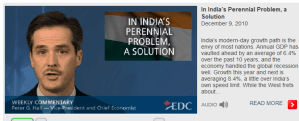
Canada’s & EDC’s Oracle Peter Hall, on India.

A message to Canadian business on the India Opportunity

EDC’s Vice President and Chief Economist Peter Hall does a Weekly Commentary on subjects that are of significance to Canada’s businesses, commerce and economic well-being. Maybe not just Canada’s well-being but the world’s. Earlier this year he went on this whirlwind 20 plus city tour of Canada as EDC’s one-man rock band or our own modern-day Oracle of Delphi, giving his insightful analysis & views on the Economy and where it was headed. But that’s not the reason why today’s blog at Rmagine headlines Peter Hall. Peter’s observations in today’s weekly commentary is closer home to Rmagine’s core- India.

This week’s analysis of global issues  for Canadian exporters and businesses featured Peter Hall delivering  a tribute,  a word of caution and a great promise of things to come- all on India. Titled ‘In India’s Perennial Problem, A Solution’, he has this to say [and I am paraphrasing]:

  • India’s modern-day growth path is the envy of most nations- annual GDP growth this year and the next to average 8.4% versus the much envied 6.4%, which is its past ten-year average.
  • Key inhibitors to growth: Infrastructure and soon, qualified labor.
  • Labor- the inhibitor and potentially, the key to further growth as well. While China’s labour force will soon peak, India will still be adding well over 100 million new workers each decade.
  • The bulk of India’s labor force is agricultural- 60%. And a great chasm..[exists] between these workers’ skills and the ample office-tower opportunities that exist. Painfully aware of this mismatch, the government is pulling out all the stops, vastly increasing education funding, expanding the number of educational institutions and partnering with international educators, in a determined race to stay ahead of the economy.
  • In the meantime….a wage inflation… could quickly erode or even eliminate India’s competitive edge.
  • The rest of the world may have a remedy. Many nations have a crying need for lower-skilled labour. Most fully developed nations have aging populations, and face desperate labour shortages in the next growth cycle. Until now, they have been able to rely on China, but it too faces imminent aging problems. India is among a very few nations with the potential to meet this chronic near-term global shortage.
  • And this is being addressed [by the Indian government], with a multi-year, US $1 trillion spending program that among other things may unlock India’s vast, and as-yet largely untapped, manufacturing potential.

And the final word from the Oracle: “The bottom line? India may well be on the verge of expanding in a new direction as the world seeks new means to keep its production machine functioning well. Strategists, pay attention.”

Peter Hall, in my opinion, is spot on. And the building blocks are all in place already for India to become a global engineering research and manufacturing hub. Of the global $200 billion engineering services outsourcing projected for 2020, India will have a 25%  or a $40 billion share. And it is projected that another $45 billion will be the value of R&D work that will be done by global majors in India by 2020. Another indicator is that auto component manufacturers in India are expected to produce between $20 to 25 billion worth of components for global auto companies by 2015.

And all this, much before the 100 million strong workforce becomes available after 2020, to prove Peter Hall right. I see his ‘Strategists, pay attention’ is really a call to Canada’s businesses to take note of the world of possibilities and plan their entry into India.

Going deeper into Peter Hall’s prescient outlook on India’s role in the global workforce of tomorrow is what India’s think tank of industry leaders label India’s New Opportunity– the opportunity to provide a skilled workforce and a band of knowledge workers to match the shortages that the western world will face. By 2020, it is predicted that US will face a net shortfall ranging from 8.2 to 14.3 million in its workforce! The net shortfall figure for Canada is expected to be between 1.1 and 2.8 million!

Going by these trends, in the future, countries from around the globe will be beating a path to India’s shores not just to do business there but to woo its knowledge workers as well.

If you’d like to listen to Peter Hall’s complete weekly commentary or read it:

http://www.edc.ca/english/docs/ereports/commentary/publications_20717.htm

Owls to Athens, India to Indians

It’s like getting a German to have a beer. During Oktoberfest!! Or, as they used to say, gifting owls to the wise in Greece. That’s what I am going to be doing later today- selling India to Indians. Specifically, Indo Canadians or persons of Indian origin, living in Canada. The Indo Canada Chamber of Commerce [ICCC] in Toronto is conducting a seminar on ‘Doing Business with/in India’ and I will have the onerous task of persuading a largely Indo Canadian audience about the potential India holds as a global market of opportunity. Apart from me from Rmagine, there will be speakers from organizations like EDC, the Ministry of Economic Development and Trade [MEDT], Deloitte and Touche.

My perspective for the presentation is not about ‘How to do business’ but largely ‘Why you MUST do business with India’. I believe, for any Canadian or US company who is interested in better growths and better profits, they need to re-imagineer their aspirations & business plans and look at global markets like India. If you are interested, click here for the event details or use the following link:      http://www.iccc.org/Website/ICCC/Calendar.nsf/vwLookupCalendarAllEventsByUNID/E31DD3D92864B565852577DE006D0C6F?OpenDocument&ppos=1&spos=0

India: Business education from Scotland?

Starting off a new series today: a catalogue of stories of success. Of businesses from all over the globe kicking-off their India ventures, either trade or direct/joint business ventures. Dubbed the India Success Stories, this first one is from the education sector and a not so likely player- Scotland. Let the inspiration flow…..

 The University of Strathclyde is to open its first overseas campus after forging a major international collaboration in India.

The initiative will see Strathclyde Business School and pioneering infrastructure firm SKIL opening a campus in Greater Noida, near Delhi, which will deliver undergraduate, postgraduate and MBA level courses.

The long-term agreement is in its final stages and is an important new link between Scotland and one of the world’s most important economies.

Scotland’s Enterprise Minister, Jim Mather, was among the first to welcome the news as he met Professor Susan Hart, Dean of Strathclyde Business School, and JP Rai, Group CEO of SKIL, in the Indian capital.

Enterprise Minister Jim Mather said: “ By expanding its reach into India, Strathclyde Business School is helping raise Scotland’s business and executive education profile on the global stage. I look forward to seeing this partnership progressing.”

Source: http://www.indianexpress.com/news/Strathclyde-Business-School-to-open-India-campus/706176

The India Opportunity Story, as told by Thomas Friedman

Here’s an interesting observation from Friedman on whether the growth stories about economies like India are real or not: ” Having traveled to both China and India in the last few weeks, here’s a scary thought I have: What if – for all the hype about China, India and globalization – they’re actually underhyped? What if these sleeping giants are just finishing a 20-year process of getting the basic technological and educational infrastructure in place to become innovation hubs and we haven’t seen anything yet? “
What if? Let’s get this provocative thought into the minds of Canadian and US entrepreneurs.

Mom! I’m calling from Mt.Everest OR Is the India hype, underhyped?

Now things are getting really interesting in India. We are not talking global majors notching up handsome growths in sales, coming in from their India expansion. That may soon be par for the course. What’s even more telling of the kind of promise that India holds for business to thrive are the new, unconventional stories of growth, stories born out of innovative entrepreneurship.

Check out two such stories in an article titled Friedman: Do Believe the Hype in India, in the Economic Times. The first one talks about the the mobile phone revolution in India, but from a different and innovative perspective- connectivity from Mt.Everest. Imagine you are on the trek of your lifetime- up the Everest and you have this uncontrollable urge to find out “how many have actually scaled the Everest? Am I the 9000th guy?” Hey, not to worry- whip out your cellphone and surf the net. Your curiosity needs to be answered, instantly. Entrepreneurship recognizes that need and has conveniently provided mobile phone connectivity now on the Everest. And hey, if you did want to indulge in your vanity and tell the world, where you are at just that moment, you may as well … indulge and make that call.

Friedman talks of another innovation- coming out of a garage in New Delhi. A mobile phone led virtual bank for migrant workers [from another Indian state called Bihar] run out of  ‘mom-and-pop’ kiosks which sell candy and cigarettes- the local ‘cornerstore’. Migrant workers use their mobile phone and the kiosk-bank-branch to open an account in a mother bank and save their daily wages or transfer money to their home and family in distant Bihar. The worker’s wife goes to another local cigarette shop and ‘withdraws’ her money, using her cell phone. Now get this… the financial services company that was born in that garage has a customer base of 180,000 and does 7000 transactions every day.

Now for the cherry-on-top, for this story of innovation: the company which runs this mobile-virtual-bank  includes graduates from India’s most prestigious institutes of technology who were working in the US but decided to come home for the action, while the chief operating officer – Matteo Chiampo – is an Italian technologist who left a good job in Boston to work here “where the excitement is”.
More businesses from Canada and the US need to be inspired to do the same.

If you’d like to read the full article:   http://economictimes.indiatimes.com/news/news-by-industry/et-cetera/Friedman-Do-Believe-the-Hype-in-India/articleshow/6865159.cms

Doing business with India….is a lot like losing weight.

Because….’you got to DO something about it’, if it is to happen.  The reason I make this point is that Canadian businesses are curious about doing business globally but that curiosity is yet to turn into action. We need to galvanize businesses to get into action mode and I feel that it is partly my responsibility to do that,  for you in turn to inspire others.

But before that, a word on why I am confident about that: because, we run a company called Rmagine, where it is our business to know about ‘doing business with India’. Rmagine, whose name comes from ‘re-imagining the future growth of businesses’ is a Market Entry Strategy Consultancy which works with Canadian and US companies who would like to expand into the Middle East and India markets. So it is our business to study these markets closely.

There is one other reason that the two are connected. They are both ‘bottomline driven’- doing business with India & losing weight. The first though is all about achieving a robust bottom-line while the second is the reverse. But fatter and robust indeed can the bottom lines of businesses be if you turned your eyes on India.

This is how I started my presentation at CME’s Global Business Exchange 2010 at Toronto’s Steam Whistle Brewery. My speech, as part of a panel of four speakers talking about the Opportunities in BRIC countries, aimed not only to showcase the India Opportunity but also serve as a clarion call to Canadian Industry and SMEs’ to act on such opportunities, not just in India but globally.

I believe that the single biggest barrier to Canada’s International trade and global presence is one of mindset and the oldest barrier in the marketing landscape- ‘habit’. But more on that later. In the meantime, if you are interested in knowing more about Doing business with India, take a look at my presentation The India Opportunity 

.

Salut. To sommelier Lindsay Groves from Canada.

Who would have guessed? A 28 year old sommelier from Burlington, Ontario in Canada, sitting across from you at the bar in the Oberoi Hotel in Mumbai, India? India’s first foriegn female sommelier, as the Toronto Star writer claims in her piece on India uncorks its finest . I’d certainly like to raise a toast to Linsay’s spirit to experience India and its world of wines. May more such spirits venture forth from corporate Canada as well to experience the opportunity that India promises for practically every Canadian industry or business.

Caroline Eden the writer has penned an evocative picture of India through the eyes of a tourist out to explore India’s new found thirst for wine. This is a part of a series of articles featured in the October 2nd issue of the Toronto Star, celebrating India on the occasion of it’s Father of the Nation Mahatma Gandhi’s birthday.

Canada’s wine country can take a note of inspiration from this piece to start exploring the potential that India has for Ontario’s own. India’s affluent [those earning >US $117,650 per year in terms of PPP], according to a McKinsey study will reach a figure of 24 million by 2025, which will be greater than the population of Australia today. And increasingly, the affluent tend to gravitate towards the wine bottle rather than hard liquor during parties these days in India. According to Stanford grad turned wine trailblazer Rajeev Samant in Mumbai, the market will double every three years. Pretty decent for Candian winemakers to take a whiff of that market today. Lindsay’s words on Indian wines ‘It’s the new world wines that work best’, could well serve as comment on the market outlook as well.

Do you know how to stuff an elephant into a match box?

The Global Business Exchange 2010 is an event conducted by the Canadian Manufacturers & Exporters [CME], to be held tomorrow at the Steam Whistle Brewing in Toronto. The Seminar is all about businesses going global. I will be one of the speakers and my focus is on The India Opportunity and what it promises for the entrepreneur who dares to venture forth.

Do you know how to stuff an elephant into a match box? No? Neither do I. But that’s exactly what I am trying to do, trying to capture the potential that India holds for businesses that want a part of the action there, in the short time available to me. I must say that I have managed just the trunk….of the elephant I mean..to stuff into the proverbial matchbox. If you are interested in attending the event, here is the link https://rmagine.wordpress.com/resources/events-of-interest/ or click here GBE 2010_1 . And if your are interested in my presentation, do check back. I intend posting it here on the Rmagine blog, after the event.

Cameron’s Indian Summer of Opportunity

Continuing Rmagine’s spotlight on news coverage across the EU on the Indian economy and opportunities, here is another from the UK’s Telegraph…Liam Halligan, the chief economist at Prosperity Capital Management writes: “…..Indian commerce is these days about so much more than “cheap labour” call-centres and Bollywood movies. India is transforming itself into a manufacturing and hi-tech superpower, fast scaling the value chain, doing what the West does but doing it cheaper. Far from being dependent on us, India’s economic prowess means it has become the source of billions of pounds of inward investment into the UK. Rather than “stealing” British jobs, Indian businesses are now more likely to provide them.”

The British Prime Minister….Liam says, ” led a travelling circus of a delegation to the sub-Continent – six ministers and 30 senior business executives. Aside from the political theatre, he wanted to show the UK is now serious about capitalizing on its deep cultural and historical ties to India, boosting commercial links with the second most populous country on earth.”.

Citing two other speeches, apart from Cameron’s, Liam presents, what he calls as the obvious shift in the balance of economic power from the developed nations to the emerging ones. World over, developed nations like the UK which has a fairly robust equity with countries like India, are making the moves to partner with India. Today, the EU accounts for over 50% of UK’s international trade while India accounts for just 2%. Cameron’s visit is all about changing that equation and there is a hurried pace to making that change happen. Canada, with over 85%  of its trade directed to the US and zero-point-something% to India is not very different. While UK may have the advantage of historical ties with India, Canada has the advantage of a huge multi-cultural base of South Asians who could be vital catalysts to closing the trade divide between Canada and India.

To read Liam’s full article: http://www.telegraph.co.uk/finance/comment/7920142/Cameron-swallows-the-bitter-pill-as-the-East-casts-shadow-over-Europe.html