GE’s Jeff Immelt would like US business to do an Avis

Jeff Immelt, the CEO of GE, minces no words in his message to businesses in the US: “There are going to be one billion consumers joining the middle class in Asia. I think for us to reduce unemployment, exports are going to be a key way to do it,”  “It’s this country’s only destiny just because most of the consumers are some place other than here.”

He also believes and I quote again: “Our competitiveness in this country today is the greatest it’s been in 25 years- I have never seen our competitiveness as solid versus India and China as I do today. We need to be all-in.”

Strong but inspiring language coming from the head of one of America’s iconic corporate brands, GE. Talking to a packed hall in Times Square, earlier this week, the CEO of the $ 177 billion dollar corporation and the Chair of  Obama’s Job Council sounded very bullish about the US winning in the global economy.

I agree and disagree with his viewpoint.

As a proponent of US and Canada having greater business ties with India, I completely agree with his viewpoint that the balance in terms of global consumption is completely tilting to countries like India. This is because a combination of many factors have collectively reached a tipping point in countries like India & China, making them the globe’s largest consumer base. While China still has to move from being ‘the world’s factory’ to ‘the world’s market’, India is striding confidently towards making internal consumption being the fuel of its growth. [Take a look at my article- “Just one reason to invest in India” in Business without Borders [BWOB], an online resource on Global Business managed by HSBC, Rogers Media and the Economist Intelligence Unit. If you are not a member of BWOB, you can also access this article here on the Rmagine Blog] . So if developed economies like the US or Canada like to have a share of that growing pie, they either have to export more to countries like India or grow their global business by setting up a base in India.

Immelt is spot-on again on observing that the US as a country is at its competitive best today when it comes to countries like India. The equation between these two nations is at its best and both countries have been very overt in their intent and action in strengthening trade ties. Where I disagree with him is on whether the US businesses are as aggressive as the Germans are about tapping that potential.

My disagreement is that I sincerely believe that a lot has been done by the US Commercial Service and US companies of all sizes in reaching out to India’s potential.  But I also understand his anguish that not enough has been done because the US business base and the product & service base that such businesses represent is so huge, that there is enormous potential to do a lot more. And the ailing US economy can certainly do with more, if corporate America can corner a larger slice of emerging markets like India.

While the Fortune 500 from the US are either already there or have plans in place to tap into the Indian economy, Immelt’s message should help in spreading the ‘good word’ to the larger section of the US SME base and the innovative & adventurous US entrepreneurial community. Small and medium-sized companies whose annual sales stretch anywhere from $ 5 to 200 million should sit up and take notice. If these businesses are interested in double-digit growth for the next decade, if not more, they should certainly draw up their plans to get a taste of India.

His message to all of America is : “Let’s do an Avis”  or “America needs to try harder” [Avis Rent a Car’s longstanding campaign against the market leader Hertz used to be ‘We try harder’.]

And as one final point in favor of that, thanks again to Immelt and GE: 18% profit growth declared by GE in the third quarter of 2011, thanks to “Our emerging market growth was very strong” as he says.

Eloquent words and figures for the US and Canadian businesses to follow.

[If you are interested in the Reuters article on Jeff Immelt’s speech at Times Square:  http://www.reuters.com/article/2011/10/20/idUS399343090920111020 ]
The future is what you can see, today

I am not talking about fortune-telling. But business vision is, in a way, fortune-telling. Two and a half years back, when we wanted to name our strategy consultancy, we looked at the core of our business idea: we were getting into the business of helping companies reimagine their future growth by directing their focus to new, emerging, high-growth markets. Hence, we named our consultancy Rmagine. Rmagine was born, to work with Canadian and US companies reimagine their future growth by helping them expand their business to the emerging markets of Middle East and India.

Fast forward thirty months  and it is very gratifying to know that 1201 CEOs’ from around the world and one of the Big 5- PricewaterhouseCoopers agree with us. I am referring to one of the recent reports from PricewaterhouseCoopers called….surprise surprise……Growth Reimagined!

PwC Report: CEO Survey 2011

In total, PwC conducted 1,201 interviews with CEOs in 69 countries. By region, 420 interviews were conducted in Western Europe, 257 in Asia Pacific, 221 in Latin America, 148 in North America (40 in Canada), 98 in Eastern Europe and 57 in the Middle East & Africa. The findings of the study are best captured by a quote from Ed Breen, Chairman & CEO of Swiss-based industrial conglomerate Tyco International, who says “Any industrial company……has to have a large presence in emerging markets. Fifteen percent of our revenue right now is coming from emerging markets, and we’re looking to double that in the not too distant future. It’s an opportunity that you have to take very seriously.”

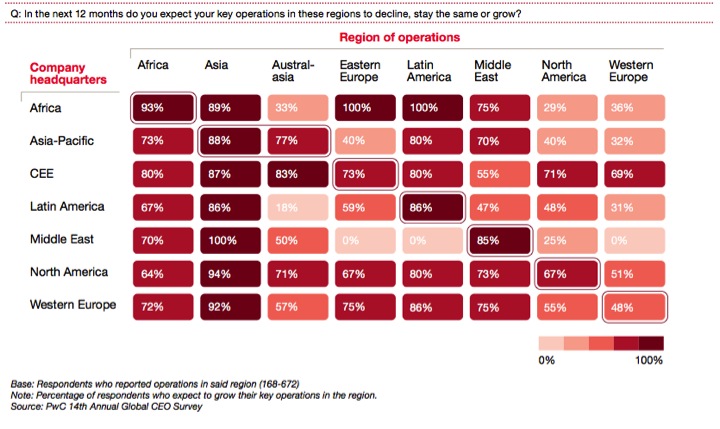
Take a good look at the numbers in the chart below summarizing the responses from 1201 CEOs’ and there is a learning for any business owner- every business needs to examine its business strategy for the future and plan for either entry into or aggressive growth in countries like India or the Middle East.

Global growth from emerging markets

Where do CEOs’ from the developed economies see their growths coming from? In Western Europe the score is 92% from Asia and 75% from the Middle East . Closer home in North America, CEOs’ predict that growths most certainly will be from Asia – 94%, with Middle East at 73%. In fact, CEOs’ across the globe, from Africa to Central & Eastern Europe, to Latin America to North America, agree overwhelmingly when it comes to Asia’s role in their growth plans- figures for Asia, as you can see, stretch from 86% to 100%.

Business learns best from other businesses. So, if you are the CEO of your business or if you are on the Board of any business, I have one question for you: Where is India and the Middle East in your business plan?

Is your vision for your company ready for some rmagination?

Canada’s Choices: Ignore or embrace the Indian customer?

CIBC Report- Canada-India Opportunity

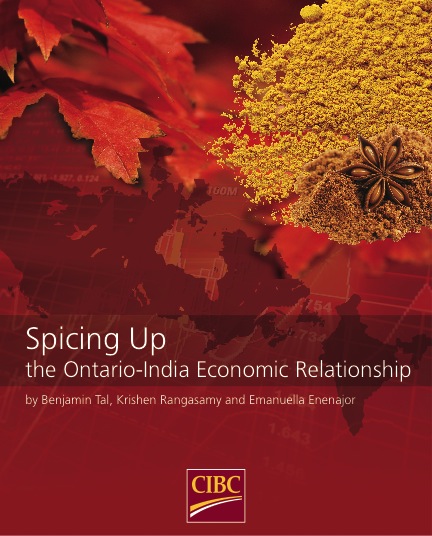
At the IIFA Global Business Forum at Toronto’s Metro Convention Centre, CIBC released a white paper titled ” Spicing Up the Ontario-India Economic Relationship”. On this occasion Benjamin Tal, the Managing Director & Deputy Chief Economist of CIBC World Markets Inc. spoke on the highlights of the research and analysis done and the findings of the paper.

As a listener, what I found heartening was that his findings and recommendations reflected exactly my thinking which I had presented at the FITT National Conference: The Opportunity Triangle.  The parallel was unmistakable. Tal’s message was strong and clear: the reality of our trade ties with the US was that we cannot continue to rely so heavily on our southern neighbour. In his foreword to the above report he says “Ontario’s predominant focus on its major and lucrative trading partner in the US has seen it largely ignore other markets and opportunities. While much discussion has taken place over the years about the need for Ontario to broaden its trading partners, until recent times the strength of the economic relationship with the US has precluded any real need to build ties with other markets”.

What he said of Ontario, in the context of the Global Business Forum and the release of the report is indeed true for Canada itself. Juxtaposing the relative slowdown of the US market with the surge of the Indian market, Tal, a key thought leader on Canada and world economy, had some choice words comparing and contrasting what was happening in the two markets. One such comparison that stuck to my mind was “the exhausted US Customer or the enthusiastic Indian Customer”. Make no mistake- he was not saying that we forsake the US market. No, we will continue to have the US as our single biggest trading partner. But the message was that we need to open up to new markets and embrace India as one of the potentially dominant partners of the future.

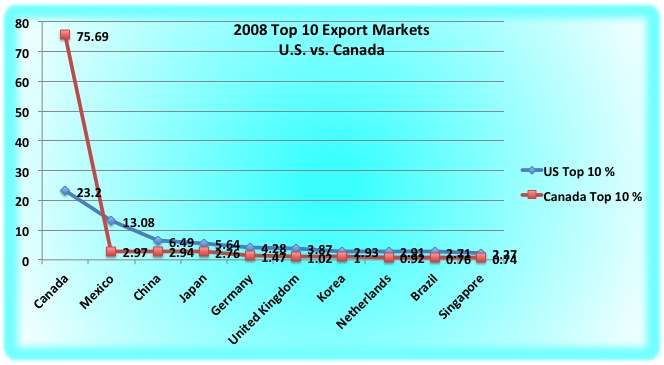
Canada's export to Rest of the World- just 14%

A quick look at the graph alongside should make things crystal clear- the top 10 US export markets account for just 67% of total US exports while for Canada, just the No.1 market- the U.S. accounts for 76 % of our exports. The next four markets- Japan, Germany, the U.K. and Mexico account for another 10%  leaving a meager 14 % for the Rest of the World’s contribution to our exports!

Waxing eloquently on the subject Tal says in the foreword to the report “….However, the rapidly changing global economy is dictating the need for Ontario to broaden its trade perspectives. India should obviously be a top priority in this shift, given the size and rapid growth of the Indian economy and the many cultural and other links between the two jurisdictions. It is clearly in the interests of both economies to see trade and investment climb from current levels.

For India, Ontario has the expertise to provide many of the products and services required as it expands its economy. This includes world recognized capabilities in many of India’s highest need areas — from developing its infrastructure by expanding its power, road and rail grids, to improving the safety of the food supply chain, to expanding educational opportunities for its young population. Given the growing role of the private sector in these sectors and services, India could clearly benefit from tapping into Canada’s stable capital markets.

For Ontario, India’s continued high rate of growth provides many opportunities to expand its export capabilities. Given Ontario’s significant Indo-Canadian population and Commonwealth and English-language ties, the opportunities for Ontario industry are significant. However, the reality is Ontario firms have been slow off the mark in developing potential opportunities in India and are lagging behind many other nations”.

What’s true for Ontario is indeed true for Canada as well. As more opinion leaders like Tal take their message out to the business community, mindsets will change and Canada & India will have much more to celebrate.

For more from the CIBC Report on why Canadian business ought to embrace India, look out for the next post.

The Opportunity Triangle- Revealed.

Last week at the FITT National Conference 2011 in Ottawa, I presented the concept of how Canada-India-Middle East combined, presents an Opportunity Triangle for Canadian businesses.

One of the key barriers to Canada’s stellar performance in the global markets is our mindset of relying heavily on trade with the US market. Hence,  the lack of diversity in our country portfolio when it comes to international trade.The Top 10 markets and the level of exports done with those Top 10 for US vs. Canada says a telling story. The Top 10 US markets combined contribute to 67% of US’ total exports while US alone accounts for 76% of Canada’s exports. And therein lies the key barrier- we just need to take our wares and sell them around the globe. More countries need to know what Canada can supply or what businesses can produce in their countries.

And this point of need for diversity in our trade and global business portfolio is endorsed by EDC’s Spring Outlook for 2011, where clearly the country’s premier Export Developmental organization says that the road to global eminence is by reaching out to the high-growth emerging markets. [More on this in my presentation]

And it is in this context that India and the Middle East hold great promise. Data and analysis on a variety of sectors show that  for practically every business, irrespective of which sector you are in, the opportunity to export & tap or expand & tap exists when you look at a market like India. Take a look at the analysis and then question yourself on whether it makes sense for your business or not. In fact your outlook would be so positive that you would start seeing India as a potential second “home market”. I guarantee you that. And the concept of the Opportunity Triangle  flows directly from that thought. There exists a third option after you set up in India as your second “home market”- of tapping the GCC countries of the Middle East from India.

India could be your gateway to a slew of markets, the low hanging fruit being the UAE, Saudi Arabia and Qatar. And the rationale for this strategy is very clear and simple. Take a look at the presentation Canada- India-Middle East.The Opportunity Triangle. If you are a business in Canada or the US, you cannot say ‘no’ to this quantum growth strategy for your business that will shape its destiny for the next couple of decades!

Canada, India & the Middle East: The Opportunity Triangle

If you are in the business of International Trade or if you are a Canadian entrepreneur or SME looking to explore the potential for your business in global markets, this year’s FITT’s 14th National Conference: The Road to Trade Success must interest you. I will be one of the speakers at this event at Holiday Inn Plaza La Chaudiere, Gatineau, QC on June 7th & 8th, 2011.

Alex Alagappan, Rmagine at the FITT Conference

My presentation “Canada, India & the Middle East: The Opportunity Triangle” is to introduce to the Canadian Business community a perspective in global marketing that spotlights the links that exist between these three markets and how they can be leveraged for your business. For a business which understands this perspective will recognize the opportunity as unique. And hence the market entry strategy that the business adopts will take into account The Opportunity Triangle. And that strategy will multiply its reach in terms of the number of markets and without doubt, its sales.

Join us at the FITT conference to learn about this Opportunity Triangle and a host of other relevant subjects from diverse subject area experts. For more on the conference, the session details, speaker profiles  and to register: http://bit.ly/kImEtM

Canadian business in India: A success story

” Waiting for the world to come to us is not an option…we have to go out to the world”.

Joseph. P Repovs, the CEO and Bob Repovs, President and COO of Samco Machinery presented their India story at the breakfast meeting organized by the Toronto chapter of The Indus Entrepreneurs [TiE], last week. The Scarborough, Ontario based roll-forming machinery manufacturer’s foray into the Indian market started with the father Joe’s visit to India to start sourcing from India for their Canadian market needs in 2005.

What drove Joe to make this trip? His belief that ” Waiting for the world to come to us is not an option…we have to go out to the world”. If his belief and enthusiasm is bottled and passed around, I am sure many an entrepreneur aspiring to grow his business would take more than a swig at it. And his positive spirit met with a significant early success- supply of machinery for one of India’s largest business houses- Tata, for their celebrated launch of Nano, the car of the masses.

Samco had some clear goals- $ 3 million in sales and cost savings of at least 30%, both of which have been achieved, even surpassed.  But not before some trying times, the most significant of which was that their Indian partner was not geared to move at the pace that Samco and the business demanded. Today Samco India is a fully owned subsidiary of the Canadian parent company.

Key lessons? Pre-planning is key. Expect results in the long run, not short term gain. Need to be there, benefit from that learning curve. Be thorough in your due-diligence on your potential partner. Be prepared to document and train employees on your way of conducting business. Be flexible, understanding and appreciative of cultural differences.

Samco is now well positioned to take advantage of the India’s burgeoning auto market and the phenomenal growth projected in a variety of industries and sectors, where roll-forming machinery will be in demand. Samco’s success has had its own dose of trials as well and according to Bob, the learning continues.  Going by the what they have achieved till now in India and Bob’s enthusiasm for the future, the day when Samco India’s operation will match its base operation in Canada is not far away. Thereby proving Rmagine’s theory that many a Canadian and US company will discover that India can well be their second “home market”.

Rmagine will meet, study and present more such successes to inspire others and help in in-market learnings.

BRICS- A Dramatically Different World

The potential of the BRICS economies, circa 2003

BRIC: A term coined by Goldman Sachs in late 2001, today it rolls off the tongue of many, globally. At a time when South Africa has just joined the group [late April 2011], for it to be rechristened as BRICS, these findings from papers published by the Goldman Sachs Global Research Centre in 2003 and an update in 2007 present a historic outlook of the promise that the developing economies of Brazil, Russia, China and India held, a decade back. [Without the dubious benefit of the  global recession that only served to accentuate the potential value of the BRIC nations vis-à-vis the developed economies]

Almost presciently, the researchers had some observations on South Africa as well, in 2003 and that’s captured in the excerpts presented here.
In its entirety, the outlook for the BRICS nations, seen in the numbers projected and playing out as we speak certainly paint a dramatically different world. Click on the image to take a look at what was predicted. And soon, you will be able to take a look at the status updated on these nations, as of 2010.

Canada’s second “home market”: India.

I believe developed markets, for the sake of their own sustenance, need to look outward and have to create what I’d like to call their second ‘home market’. As growth tapers and as a product’s ‘home market’ ages, the imperative is that it has to create it’s new second ‘home market’ in today’s shifting economic sands. Products, services, technology, systems & processes and brands can be leveraged by businesses in a developed market, like Canada, to its advantage, by tapping into the growth of an emerging, growing, young market like India.

Companies that aspire to live and prosper into the next fifty or hundred years need to look at international markets as much more than tapping ‘new’ markets. And with rising oil prices impacting the supply chain costs and consequently the cost of goods,  businesses can’t just source & assemble everything in one location but start viewing markets with some old fashioned sensibility- the concept of ‘home market’. Only in this case, a truly global corporation needs to create many home markets. Each home market will then become a base for the corporation to tap a part of the globe. So companies need to view their emerging market ventures as not just a satellite  market to add to its home market volumes but as a whole new home base to venture forth into new worlds.

To start with, companies and organizations have to build their second ‘home market’. That market which they will sink roots into and make their own, not just for what that emerging market promises but to conquer new worlds and markets from there. And if one asks Canada to choose which market will serve it well as its SECOND ‘HOME MARKET’, I would like to submit that it should be INDIA.

Chew on that folks. More on this soon.

Rmagine in the media. “One. Just one reason to invest in India”

Forget the ‘twentyone’ reasons why….. to do anything. We will keep it short and simple for all those Canadian and US businesses looking to expanding into new global markets.

If you want to examine why your business may want to consider India, I have just one reason. To know more, I’d like you to take a look at my article as a guest writer and blogger on Business without Borders. I really hope  I am able to get a few businesses and entrepreneurs to get a lot more curious about India and the opportunity she holds for the wise & brave….

Emerging Markets Consumer Survey- India

Thanks to Credit Suisse Research, a research done by AC Nielsen on the Emerging Markets Consumer has some very revealing facts for Canadian and US businesses looking to India as a potential market. The survey was done among 13,000 adults in Brazil, India, China, Russia, Latin America, Indonesia and Saudi Arabia.

Key pointers:

  • Mood of Confidence- 43% of Indian consumers feel that the state of their personal finance over the next six months will be better. 54% feel that it will remain as good as it is. Only 3%, lowest for all countries surveyed, feel it will get worse.
  • The number of high-income households[HH], is more than twice that of Russia, despite the GDP per capita being 80% lower than Russia
  • Spending will move from ‘necessity’ to discretionary- survey shows that there is a clear and consistent pattern in consumption of branded goods as income levels improve. And of international brands to local brands at the affluent level.
  •  A priority that stands out for the Indian consumer is education. Household spending on education is by far the highest within the survey at around 7.5% (more than twice that of Russia, at 3.1%). Add to that is the finding that the percentage of school age population to the total population stands the highest at 20%.  Both these factors clearly point to the potential that India holds for the education sector
  • Some purchase intentions across low to affluent income groups, for the next 12 months- 61 to 67% expect to spend more on dairy products, 36 to 61% expect to spend more on feminine hygiene products, 27 to 41% on bottled water, 42 to 50% on soda-pop, 4 to 10% more on healthcare, 8 to 13% more on education and training, 18 to 28% on purchasing branded sports shoes, 2 to 4% on purchasing smart phones, 4 to 10% on purchasing computers

Consumption is certainly a big story for India, given  the huge, young population, rising affluence, increased urbanisation and change in psyche. Most products and brands of developed markets across all categories tend to benefit. Specifically the education, healthcare, food and beverage, entertainment, lifestyle products and brands form Canada and the US have a great opportunity.

More on India’s consumer from the Credit Suisse Emerging Markets Survey will be coming up in Part II. Happy hunting.