
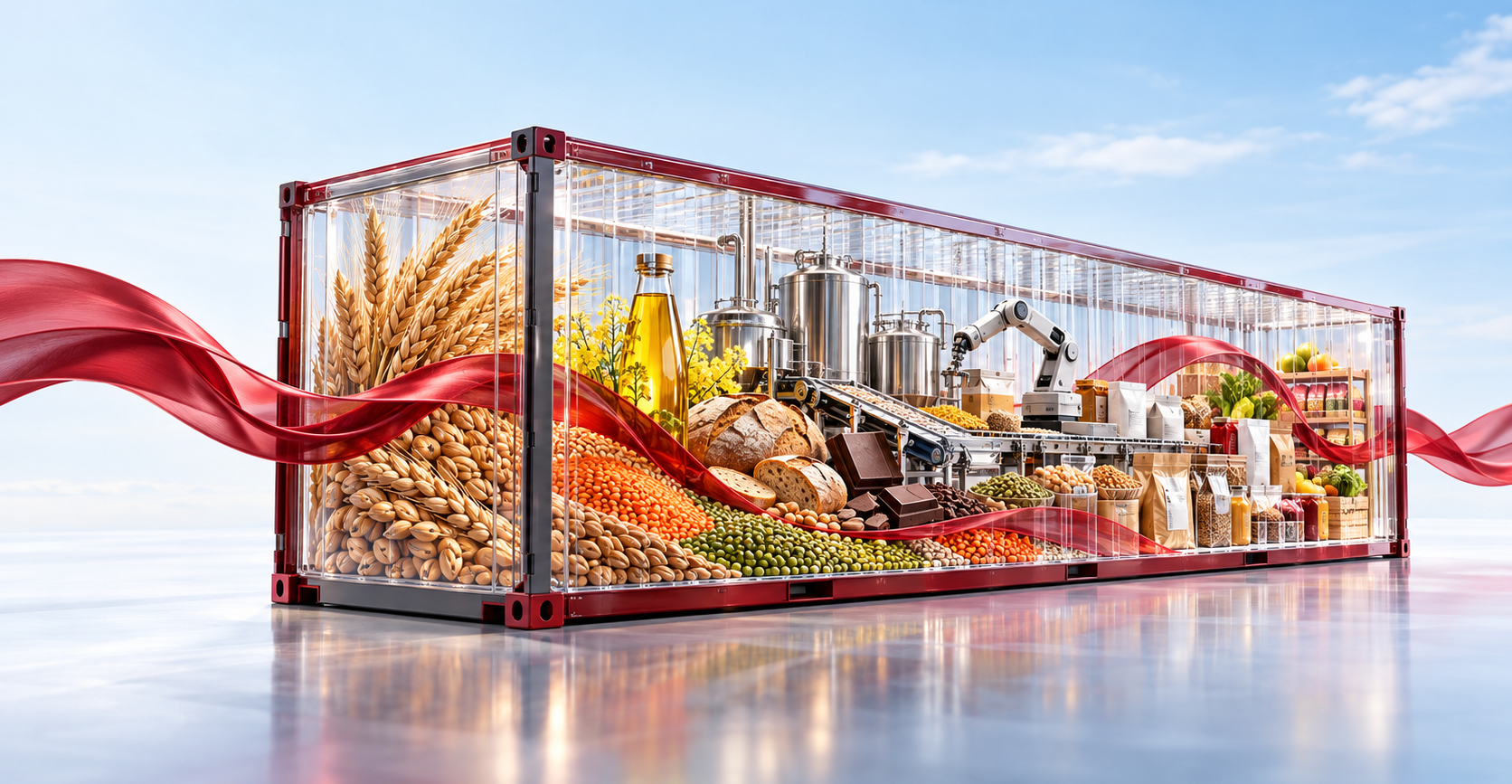
Your next Indian customer could buy your finished product, use your ingredients or want the technology behind both.
Could India be your next food market?
Are you a Canadian food business that has spent years earning its place on American shelves? Your products are proven, your production line is established, and your export team is experienced. If uncertainty in the US is prompting you to look for your next market, India deserves a closer look.
You already have something valuable to take there: a product customers buy, a process that delivers consistently, or expertise another manufacturer could use. The question is where that capability meets an Indian business’s ambitions.
Canada exported C$59.8 billion in processed food and beverages in 2024; 80% went to the US, according to Agriculture and Agri-Food Canada. For a business seeking to broaden its customer base, that established export capability is an asset to put to work.
At Rmagine, we feel the most promising starting point is often the product you can supply today. A differentiated bakery line, a food-service product or a specialist ingredient could open an export conversation while you explore the larger possibilities of an Indian partnership.

You supply America. What could India put on your menu?
If India still feels like an unfamiliar prospect, start with food categories you already know. Canadian suppliers have built substantial US businesses in oils, chocolate preparations and bakery products. India has established consumer markets in the same broad food families, with further growth forecast.
In 2024, Canadian canola oil sales to the US were worth US$2.61 billion. India’s broader edible oils retail market was US$24.36 billion, with Euromonitor forecasting US$35.11 billion by 2029. Canadian chocolate preparations sold to the US were worth US$1.09 billion; India’s confectionery market stood at US$4.12 billion and is forecast to reach US$5.39 billion.
Bakery offers another useful perspective. Canada supplied US$4.17 billion in bakery products to the US in 2024. India’s baked goods retail market was US$3.52 billion, with a forecast of US$5.18 billion by 2029. For a Canadian producer, that raises practical questions about which products, ingredients or production capabilities could interest an Indian buyer.
At Rmagine, we feel these figures give you a reason to begin the conversation. Your first Indian customer could be a distributor seeking a differentiated product, or a local manufacturer looking to improve its range through your ingredients, recipes or production expertise.

India’s food market: look inside the basket
McKinsey estimates India’s agricultural processing sector at about US$330 billion. To see some of the consumer categories within the wider food economy, consider Euromonitor’s packaged-food data, published by AAFC: dairy alone generated US$31.7 billion in Indian retail sales in 2024, edible oils US$24.4 billion, and rice, pasta and noodles US$16.3 billion. Savoury snacks and sweet biscuits, snack bars and fruit snacks each approached US$6.9 billion.
Those categories suggest several conversations. If you make bakery products, where might your recipes, frozen formats or production expertise fit? If you supply ingredients, which Indian manufacturer wants to add protein, improve texture or develop a new snack? If your strength is processing, who is expanding a dairy or convenience-food line?
BCG describes the innovation challenge as “innovate for nutrition, taste, and affordability.” Your advantage might be a formulation, a more efficient production method, or a distinctive product that earns its place in an existing range.
The accompanying category chart shows where that range is expected to grow—and offers a starting point for deciding which part of India’s food basket deserves your attention.

Your ingredient could be inside India’s next bestseller
Canada’s food relationship with India already has a substantial foundation. Canadian-reported agri-food and seafood exports reached C$1.42 billion in 2024, with peas and lentils accounting for approximately 98%. The next chapter could carry more Canadian value into the products made from those crops.
Pulse Canada points to opportunities for collaboration as pulse ingredients enter a wider range of processed foods. Think beyond the commodity shipment: flour for a bakery formulation, protein for a snack, or ingredient expertise for a manufacturer developing a new range.
An Indian producer with an established brand and distribution network could be your customer, your development partner, or both. You bring an ingredient or capability; the partner brings knowledge of local recipes, consumers and routes to market.
At Rmagine, we see this as a particularly useful way to examine India: look for businesses whose next stage of growth calls for something you already do well.

The opportunity also runs through the factory
Perhaps you manufacture the equipment that makes food safer, more consistent or easier to distribute. India’s expansion gives you another set of buyers to consider: processors, dairy businesses, cold-store operators and logistics companies.
India’s next phase of cold-chain investment deserves your attention. Pradhan Mantri Kisan SAMPADA Yojana (PMKSY), a government program supporting food-processing infrastructure, has helped build capacity across storage, quick freezing, milk processing and refrigerated transport.
The National Centre for Cold-chain Development’s 2025 study projects 43.65 million tonnes of cold-storage capacity and more than 33,000 reefer vehicles by 2031. Its roadmap highlights compressors, motors, insulation and remote monitoring; ministry guidance reinforces efficient cooling. For Canadian suppliers, these are concrete applications to examine.
A local equipment integrator or specialist representative could help you reach purchasing teams and support installations. A manufacturing or licensing partner could offer another route for a Canadian business with a process worth replicating.

A changing shopping basket needs new routes to market
The way Indian consumers buy food is changing too. Bain and Flipkart report that quick commerce accounted for more than two-thirds of e-grocery orders in 2024. That makes discovery, availability and frequent replenishment part of the opportunity for a Canadian food brand.
For your business, the opening might be a locally stocked snack range offered through an importer with digital-channel relationships. It might be frozen products supplied to restaurant groups, or ingredients sold directly to manufacturers. Each calls for a different partner and commercial proposition.
India’s many small purchasing occasions can add up to a market that matters to a Canadian company. You could begin with one consumer segment, one metropolitan cluster or a handful of manufacturers with a shared need.
At Rmagine, we believe the interesting question is: which of those pockets of demand is large enough to advance your growth plans, and close enough to your capabilities to pursue?

What would put your business on India’s menu?
Begin with your strongest proposition. Identify the buyer, the improvement you offer and the partner who can help you deliver it. That creates a focused opportunity to explore—and a basis for deciding where deeper research would earn its keep.
India offers several doors worth opening. Which one fits what you do best?
Let’s start a conversation
At Rmagine, we help businesses identify market opportunities, assess potential partners and develop practical routes into markets such as India. We have developed go-to-market strategies for Canadian and US businesses, including Canadian clients of the Business Development Bank of Canada [BDC], seeking opportunities in India. We offer a no-commitment introductory call to examine the opportunity or the problem you would like to address. Maybe our discussion would springboard some new ideas for your business growth. If there is a meeting of minds, we can agree on the next step together.
Connect with us. Or write to alex@rmagine.com.
Leave a Reply